The Algorithm of Behaviour in the Age of Digital Twins: Personality
Baltas Group
The concept of a digital twin refers to a representation of a real-world system that is created in a digital environment and continuously updated. This approach first emerged in engineering and manufacturing. The aim is not only to observe a physical system but also to understand its behaviour better and to predict its possible future states. By representing a machine, a production line or a complex technical system digitally, the changes that take place become easier to monitor. The model is continuously updated with data from the physical system, creating a structure that lives in the digital environment. A digital twin is therefore not just a record-keeping system; it is a model that changes over time. Today, the digital twin approach is no longer limited to machines and is seen as a broader way of thinking used to understand complex systems.1,2
The human digital twin: A new approach to understanding behaviour
With recent developments, people have begun to discuss whether digital twin technology could also be used to model humans. When people’s communication styles, working habits, reactions at moments of decision or tendencies in different situations are brought together, certain recurring patterns can be seen. These patterns are closely related not only to observed behaviour but also to cognitive and emotional processes, such as how individuals make sense of events, which information they take into account and how they take action.
Human digital twin studies try to understand this multi-layered structure through data and focus on developing models that make individual-specific patterns visible. In this way, how individuals might think, react or which choices they might lean towards in different situations is evaluated within a broader framework. Research shows that the systematic analysis of data can contribute to understanding individuals’ decision-making processes and working styles.3
Personality: The order behind behaviour
The concept of personality offers an important framework for understanding these patterns. In the psychology literature, personality is defined as a set of relatively enduring characteristics that explain how a person tends to think, feel and behave in different situations. Contemporary approaches such as the Five Factor Model show that people have different tendencies in areas such as openness, conscientiousness, introversion–extraversion, agreeableness and emotional stability. Research based on the behavioural traces people leave in digital environments has shown that these personality tendencies are associated with specific behaviour patterns.4 At this point, a digital twin can be seen less as a structure that directly measures personality and more as a tool that helps us understand how personality is reflected in patterns.
One of the most striking reviews on using digital twin technology to analyse personality through social media data belongs to Tandon and Mehra.5 The studies they examine show that the digital footprints users leave on platforms such as Facebook, Twitter and LinkedIn can be analysed through psychological models. Accordingly, it is possible to make predictions about personality traits using data such as the content individuals share, the images they upload, the structure of their friendship networks, group memberships, interaction frequency and liking behaviour. These studies show that digital behavioural data is becoming an increasingly important source of data for psychological analysis.
In recent years, large language models and AI-based simulations have led to new research into modelling human behaviour in digital environments. In a study conducted by Stanford University’s Institute for Human-Centered Artificial Intelligence, AI-based digital twins representing the behaviour and preferences of 1,052 individuals were created.6 In this study, detailed data was collected about participants’ values, attitudes and decision-making styles, and a separate digital representation was developed for each individual using this data. The results showed that the digital agents could predict individuals’ attitudes and decisions with high accuracy. The simulations were able to anticipate people’s views on certain social or political issues and their behavioural tendencies. These developments show that, when evaluating the success of digital twins, attention must also be paid to how far the resulting digital representations actually reflect individuals.
Authenticity in the digital twin: What does it mean to reflect reality?
When it comes to digital twins, how accurately the model represents reality is expressed in the literature through the concept of “fidelity”. However, this does not mean creating a flawless copy. The aim of a digital twin is not to produce an exact replica of reality but to provide a representation that is accurate enough for a specific purpose. A model can be very detailed, but if it is not up to date it may struggle to reflect reality. Likewise, a model that is updated very quickly but works with superficial data cannot capture the real structure of behaviour. Fidelity therefore requires the model both to be fed with current data and to be able to capture meaningful patterns. Research shows that maintaining alignment between the digital model and the real system is important for the model’s reliability.7,8
In this context, one study examined the concept of “believability” in human–AI interactions through personality. The results showed that conscientiousness in particular plays an important role in digital agents being perceived as reliable. Agreeableness and extraversion were also found to increase the naturalness of the interaction. In contrast, as emotional instability increased, users rated the interaction as less believable.9
Behaviour patterns in working life and the “Digital Sage”
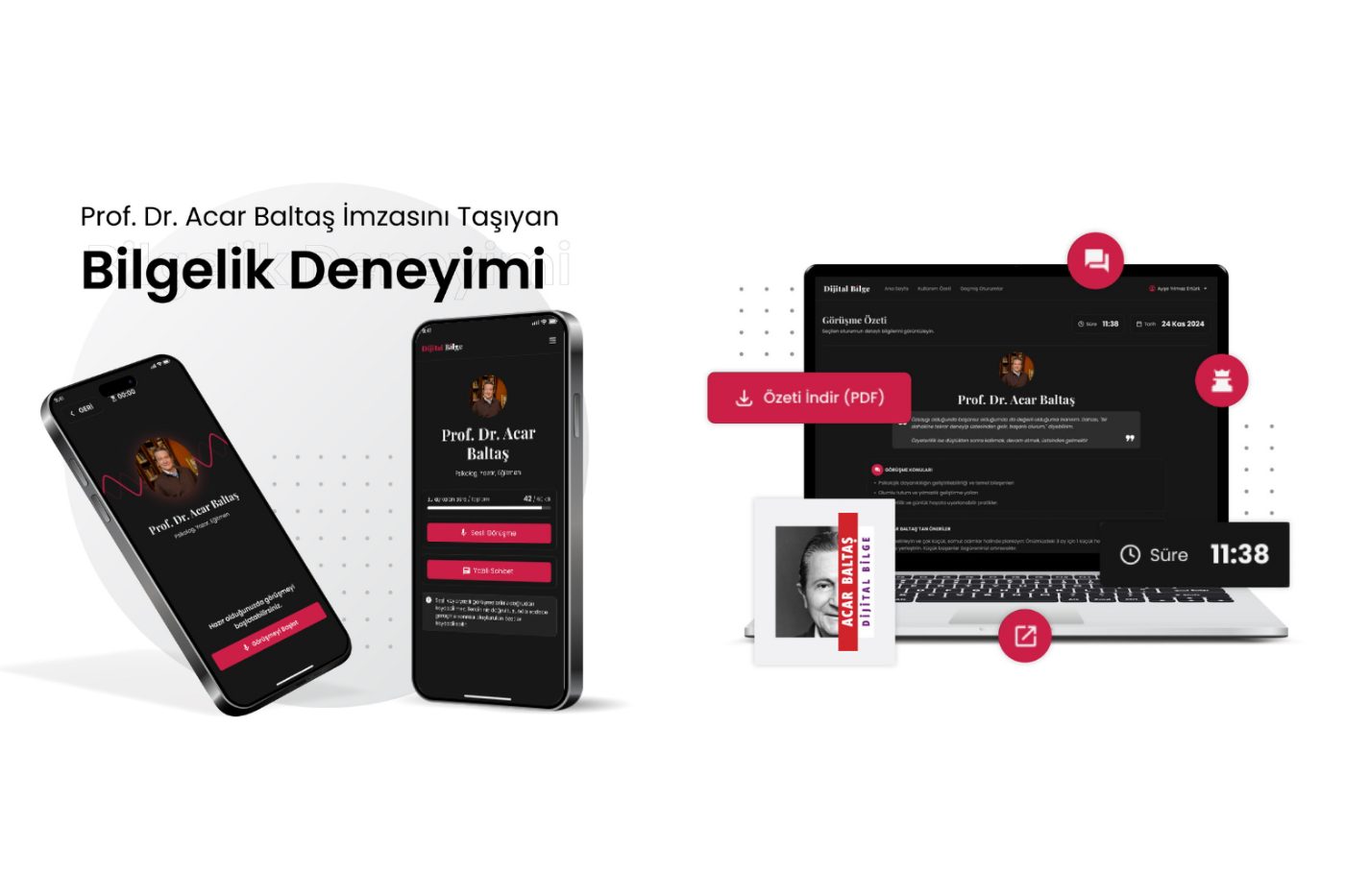
Many situations encountered at work cannot be explained by technical processes alone. How employees interpret events, the emotions with which they react and how they behave, in other words ways of working shaped along the thought–emotion–behaviour axis, significantly affect outcomes in the workplace. People tend to react in similar ways under similar conditions. However, because they do not always have the opportunity to see their own behaviour patterns from the outside, these recurring patterns often go unnoticed. Yet many recurring situations in working life are strongly related to individuals’ personality traits. Understanding personality can therefore help many processes in working life to be evaluated more soundly. So is it possible to make visible the behaviour patterns that individuals often maintain without realising? Developments in artificial intelligence and digital modelling have begun to produce new answers to this question. One of these approaches is the “Digital Sage”, which makes the knowledge and experience of Prof. Dr. Acar Baltas accessible in a digital environment. Developed by Enocta in collaboration with Baltas Group, the “Digital Sage” addresses the relationship between technology and human behaviour in a new dimension. Bringing wisdom to the scale of the organisation, this structure aims not so much to be a system that offers ready-made answers as to create a space for thinking that helps individuals better evaluate the situation they are in. The “Digital Sage” helps people see the context more clearly at moments of decision and contributes to evaluating the situation from different angles. In this approach, technology is not a tool that makes decisions on behalf of people. Rather, it is seen as an aid that supports thinking and makes it easier for individuals to make their own assessment. The “Digital Sage” can therefore be seen as an example showing that digital tools can evolve from systems that merely provide information into structures that accompany individuals’ thinking and evaluation processes.
Conclusion
Digital twin technology is a powerful modelling approach developed to understand complex systems. Over time, this approach has also inspired studies aimed at understanding human behaviour. The concept of the human digital twin offers a framework that allows individuals’ behaviour patterns to be seen more clearly.
Personality traits play an important role in understanding these patterns. The behavioural traces left in digital environments can provide meaningful information about individuals’ thinking and decision-making tendencies. In the age of digital twins, personality forms the fundamental framework that explains the order behind behaviour, while the digital twin can be seen as a tool that helps to monitor and model how this order emerges over time. The “Digital Sage” approach developed by Prof. Dr. Acar Baltas with Enocta is a guide that brings technology into moments of decision at exactly this point.
Sources:
- Glaessgen EH, Stargel D. The Digital Twin Paradigm for Future NASA and U.S. Air Force Vehicles. AIAA; 2012.
- Fuller A, Fan Z, Day C, Barlow C. Digital twin: Enabling technologies, challenges and open research. IEEE Access. 2020;8:108952–71.
- Lin Y, Chen L, Ali A, Nugent C, Cleland I, Ding J, Ning H. Human digital twin: A survey. J Cloud Comput. 2024;13:131.
- Azucar D, Marengo D, Settanni M. Predicting the Big Five personality traits from digital footprints on social media: A meta-analysis. Pers Individ Dif. 2018;124:150–9.
- Tandon V, Mehra R. Study of approaches to predict personality using digital twin. In: Neuromorphic Computing [Internet]. London: IntechOpen; 2023.
- Stanford Institute for Human-Centered Artificial Intelligence (HAI). AI agents simulate 1,052 individuals’ personalities with impressive accuracy [Internet]. Stanford: Stanford University; 2025 Jan 21.
- Kritzinger W, Karner M, Traar G, Henjes J, Sihn W. Digital twin in manufacturing: A categorical literature review and classification. IFAC-PapersOnLine. 2018;51(11):1016–22.
- Liu W, et al. A 5M synchronization mechanism for digital twin shop-floor. Chin J Mech Eng. 2023.
- Cohen MC, Su Z, Kao HT, Nguyen D, Lynch S, Sap M, et al. Exploring Big Five personality and AI capability effects in LLM-simulated negotiation dialogues [Internet]. arXiv; 2025.
- Jones D, Snider C, Nassehi A, Yon J, Hicks B. Characterising the digital twin: A systematic literature review. CIRP J Manuf Sci Technol. 2020;29:36–52.
Meet Personova Right Now
You can contact us to get information about Personova developed by Baltas Group.
Phone
+44 7557 347 733Address
63-66 Hatton Garden
London, England, EC1N 8LE